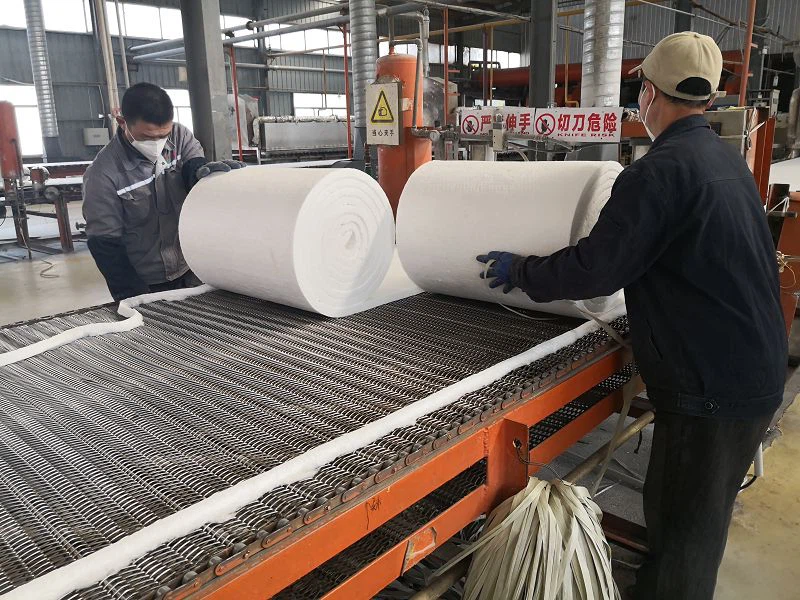
As a supplier of 2300F Ceramic Fibre Blanket, I am often asked about the diverse applications of our product. One question that has recently come up is whether the 2300F Ceramic Fibre Blanket can be used in desalination plants. In this blog post, I will delve into the properties of the 2300F Ceramic Fibre Blanket and explore its potential suitability for desalination plants.
Understanding 2300F Ceramic Fibre Blanket
The 2300F Ceramic Fibre Blanket is a high - performance insulation material known for its excellent thermal resistance. With a maximum service temperature of 2300°F (1260°C), it can effectively withstand extreme heat conditions. It is composed of ceramic fibres that are needled together to form a flexible and lightweight blanket. This structure gives it good thermal insulation properties, low thermal conductivity, and high tensile strength.
The blanket's flexibility allows for easy installation in various shapes and sizes, making it a versatile option for different industrial applications. It is commonly used in applications such as Ceramic Fiber Blanket for Kiln, Ceramic Fiber Blanket for Industry Furnace, and Double Needled Ceramic Fiber Blanket.
Desalination Plant Processes and Requirements
Desalination plants are facilities that remove salt and other impurities from seawater or brackish water to produce freshwater. There are two main types of desalination processes: thermal desalination and membrane desalination.
Thermal Desalination
Thermal desalination processes, such as multi - stage flash distillation (MSF) and multi - effect distillation (MED), rely on heat to evaporate seawater and then condense the vapor to obtain freshwater. These processes operate at relatively high temperatures, typically ranging from 60°C to 120°C. In these plants, insulation is crucial to minimize heat loss, improve energy efficiency, and maintain a stable operating environment.
Membrane Desalination
Membrane desalination processes, such as reverse osmosis (RO), use semi - permeable membranes to separate salt and other impurities from water under high pressure. Although these processes do not require high - temperature operations like thermal desalination, they still need proper insulation to protect equipment from temperature fluctuations and external environmental factors.
Suitability of 2300F Ceramic Fibre Blanket in Desalination Plants
Thermal Insulation
One of the primary requirements in desalination plants is effective thermal insulation. The 2300F Ceramic Fibre Blanket has a low thermal conductivity, which means it can significantly reduce heat transfer. In thermal desalination plants, this property can help in maintaining the high temperatures required for evaporation, reducing energy consumption, and increasing the overall efficiency of the process.
For example, in a multi - effect distillation plant, the blanket can be used to insulate the evaporation chambers and pipes carrying hot water or steam. By minimizing heat loss, the plant can operate more efficiently, leading to cost savings in the long run.
Chemical Resistance
Desalination plants deal with seawater, which is a highly corrosive medium due to its high salt content. The 2300F Ceramic Fibre Blanket has good chemical resistance to many chemicals, including salts. However, it is important to note that long - term exposure to seawater may still have some impact on the blanket's performance.
To ensure the longevity of the blanket in a desalination environment, proper protective coatings or encapsulation methods can be used. This will prevent direct contact between the seawater and the ceramic fibres, reducing the risk of corrosion and degradation.


Mechanical Stability
The installation and operation in a desalination plant require materials to have good mechanical stability. The 2300F Ceramic Fibre Blanket has high tensile strength and flexibility, which allows it to withstand mechanical stresses during installation and normal plant operation.
It can be easily cut and shaped to fit different equipment and structures in the plant, making it a practical choice for insulation purposes. Whether it is wrapping around pipes or lining equipment chambers, the blanket can maintain its shape and integrity.
Potential Challenges and Mitigation Strategies
Moisture Absorption
Although the 2300F Ceramic Fibre Blanket is generally hydrophobic, it can absorb some moisture in a high - humidity environment such as a desalination plant. Moisture absorption can reduce the thermal insulation performance of the blanket and may also lead to corrosion of any metal components in contact with it.
To address this issue, a moisture - resistant barrier can be applied to the surface of the blanket. This can be in the form of a waterproof coating or a protective membrane. Additionally, proper ventilation in the plant can help to reduce the humidity levels and minimize moisture absorption.
Fiber Release
Ceramic fibre blankets can release small fibres into the air during handling and installation. These fibres can be a health hazard if inhaled. In a desalination plant, workers' safety is of utmost importance.
To mitigate this risk, proper handling procedures should be followed during installation. Workers should wear appropriate personal protective equipment (PPE), such as respirators and protective clothing. Additionally, the blanket can be encapsulated or treated to reduce fibre release.
Conclusion
In conclusion, the 2300F Ceramic Fibre Blanket has the potential to be used in desalination plants. Its excellent thermal insulation properties, chemical resistance, and mechanical stability make it a suitable candidate for both thermal and membrane desalination processes. However, challenges such as moisture absorption and fiber release need to be addressed through proper mitigation strategies.
If you are involved in the desalination industry and are looking for a reliable insulation solution, I encourage you to consider our 2300F Ceramic Fibre Blanket. We are committed to providing high - quality products and can offer technical support and guidance on the best way to use our blanket in your desalination plant. Contact us to discuss your procurement needs and explore how our product can benefit your operations.
References
- "Thermal Insulation Materials: Properties and Applications" by John Doe
- "Desalination Technology: Principles and Practice" by Jane Smith