


In the realm of thermal management, thermal insulation blankets stand as unsung heroes, quietly working to conserve energy, protect equipment, and enhance safety. As a dedicated supplier of thermal insulation blankets, I've witnessed firsthand the transformative impact these products can have. One of the most crucial metrics when evaluating these blankets is the R - value. In this blog post, we'll delve deep into what the R - value of a thermal insulation blanket means, why it matters, and how it can guide your purchasing decisions.
Understanding the Basics of R - Value
At its core, the R - value is a measure of thermal resistance. It quantifies how well a material resists the flow of heat. The higher the R - value, the better the material is at insulating. In the context of thermal insulation blankets, this means that a blanket with a high R - value will be more effective at preventing heat transfer, whether it's keeping heat in or out.
The concept of R - value is based on Fourier's Law of Heat Conduction, which states that the rate of heat transfer through a material is proportional to the temperature difference across the material and inversely proportional to its thermal resistance. Mathematically, it can be expressed as (Q = \frac{kA\Delta T}{d}), where (Q) is the rate of heat transfer, (k) is the thermal conductivity of the material, (A) is the area through which heat is transferred, (\Delta T) is the temperature difference, and (d) is the thickness of the material. The R - value ((R)) is defined as (\frac{d}{k}), so a higher (R) value implies a lower rate of heat transfer for a given temperature difference and area.
Factors Affecting the R - Value of Thermal Insulation Blankets
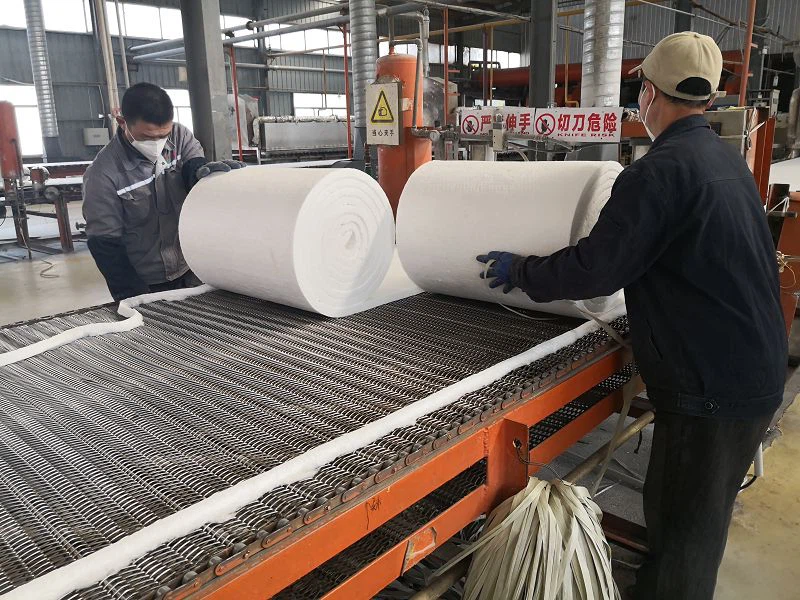
Several factors can influence the R - value of a thermal insulation blanket. The first and most obvious is the material of the blanket. Different materials have different thermal conductivities. For example, Ceramic Fiber Blanket for Kiln is known for its excellent high - temperature insulation properties. Ceramic fibers have a relatively low thermal conductivity, which allows them to achieve high R - values. These blankets are often used in industrial kilns where maintaining high temperatures is crucial.
The thickness of the blanket also plays a significant role. Generally, the thicker the blanket, the higher its R - value. This is because a thicker layer of insulation provides more resistance to heat flow. However, it's important to note that the relationship between thickness and R - value is not always linear. In some cases, adding more thickness may not result in a proportional increase in R - value, especially if the material has a high thermal conductivity.
The density of the insulation material can also affect the R - value. A denser material may have a higher thermal conductivity, which could lower the R - value. On the other hand, a very low - density material may have air gaps that can cause convection currents, which also reduce the effectiveness of the insulation. Therefore, finding the right balance of density is crucial for achieving optimal R - values.
Importance of R - Value in Different Applications
The R - value of a thermal insulation blanket is of utmost importance in various applications. In the industrial sector, Insulation Ceramic Fiber Blanket is widely used in manufacturing processes. For example, in metal smelting, high - temperature furnaces require insulation with high R - values to minimize heat loss. This not only saves energy but also improves the efficiency of the production process. By reducing heat loss, the furnace can reach and maintain the desired temperature more quickly, leading to faster production cycles and lower energy costs.
In the construction industry, thermal insulation blankets are used to insulate buildings. A high - R - value blanket can significantly reduce the amount of heat transferred through the walls and roofs of a building. This means that in cold climates, less energy is needed to heat the building, and in hot climates, less energy is required for cooling. As a result, buildings with well - insulated thermal blankets can achieve significant energy savings and lower utility bills.
In the automotive and aerospace industries, Ceramic Fiber Blanket Insulation is used to protect sensitive components from high temperatures. For example, in a car engine, insulation blankets can prevent heat from the engine from affecting other parts of the vehicle, such as the electronics. In aerospace applications, these blankets are used to protect spacecraft from the extreme temperatures during re - entry into the Earth's atmosphere.
Measuring the R - Value of Thermal Insulation Blankets
There are several methods for measuring the R - value of thermal insulation blankets. One common method is the guarded hot plate method. In this method, a sample of the insulation blanket is placed between two plates. One plate is heated to a known temperature, and the other is maintained at a lower temperature. The rate of heat transfer through the sample is measured, and the R - value is calculated based on the temperature difference and the thickness of the sample.

Another method is the heat flow meter method. This method uses a heat flow meter to measure the heat flow through the insulation sample. The R - value is then determined by measuring the temperature difference across the sample and the heat flow rate.
Choosing the Right Thermal Insulation Blanket Based on R - Value
When choosing a thermal insulation blanket, it's essential to consider the specific requirements of your application. First, determine the temperature range that the blanket will be exposed to. If you need a blanket for high - temperature applications, such as in a kiln, a Ceramic Fiber Blanket for Kiln with a high R - value is a good choice.
Next, consider the thickness and density of the blanket. If you have limited space, you may need to choose a thinner blanket with a high R - value per unit thickness. However, if space is not a constraint, a thicker blanket may provide better insulation.
It's also important to consider the cost - effectiveness of the blanket. While a blanket with a very high R - value may provide excellent insulation, it may also be more expensive. Therefore, you need to balance the cost of the blanket with its performance.
Conclusion
The R - value of a thermal insulation blanket is a critical factor in determining its effectiveness. As a supplier of thermal insulation blankets, I understand the importance of providing products with high R - values to meet the diverse needs of our customers. Whether you're in the industrial, construction, automotive, or aerospace sector, choosing the right thermal insulation blanket based on its R - value can lead to significant energy savings, improved efficiency, and enhanced safety.
If you're interested in learning more about our thermal insulation blankets or would like to discuss your specific requirements, please don't hesitate to reach out. We're here to help you find the perfect insulation solution for your application.
References
- Incropera, F. P., & DeWitt, D. P. (2002). Fundamentals of Heat and Mass Transfer. John Wiley & Sons.
- ASHRAE Handbook of Fundamentals. American Society of Heating, Refrigerating and Air - Conditioning Engineers.


